
Ganga Aarti at Har Ki Pauri, Morning (Dawn): Between 5:15 AM and 5:45 AM
The city of Haridwar, situated at the base of the majestic Himalayas, serves as the sacred threshold where the River Ganges transitions from its rugged mountain path to the vast Indian plains. Known traditionally as the 'Gateway to God,' it is one of the seven holiest sites in Hinduism, steeped in millennia of spiritual history and mythological lore. Legend tells us that this is the very spot where the sage Bhagiratha successfully brought the Ganges to Earth to liberate the souls of his ancestors, a feat commemorated at sites like Kapilastaan. Beyond its local legends, Haridwar acts as the vital entry point for pilgrims embarking on the Char Dham Yatra to Badrinath, Kedarnath, Gangotri, and Yamunotri, making it the spiritual anchor of the entire Uttarakhand region. The daily rhythm of the city is defined by a deep sense of devotion, centered around the iconic Har Ki Pauri ghat. Here, the river is believed to have been touched by celestial nectar, and a footprint of Lord Vishnu is said to be imprinted in the stone. As evening descends, the city transforms during the Ganga Aarti, a spectacular ritual where the sounds of rhythmic chanting and ringing bells harmonize with the glow of thousands of flickering lamps. These floating offerings, released by devotees of Shiva and Vishnu, turn the river into a moving tapestry of light. This atmosphere of sanctity is further enhanced by the countless ashrams and dharamshalas that line the banks, offering a haven for meditation and the study of ancient Vedic sciences. Haridwar’s significance reaches a global scale during its massive religious congregations, most notably the Kumbh Mela. Held every twelve years, along with the Ardh Kumbha every six years, these festivals draw tens of millions of pilgrims from across the globe, all seeking to purify their karma in the holy waters. Even outside of these major years, the city remains a bustling hub of culture and tradition, particularly in April during the Hindu solar new year. Whether exploring the hilltop temples of Mansa Devi and Chandi Devi via cable car or observing the meticulously kept family lineages recorded by the city’s hereditary priests, visitors find that Haridwar offers a profound connection to India’s living heritage and timeless spiritual identity.
The Ganga Aarti at Har Ki Pauri is a deeply rhythmic ceremony that follows the natural cycle of the sun. Because the rituals are timed to coincide with sunrise and sunset, the exact minutes shift throughout the year. For April 2026, the typical schedule is as follows:
Morning (Dawn): Between 5:15 AM and 5:45 AM. | Evening (Dusk): Between 6:15 PM and 6:45 PM.
Practical Tips for Visitors
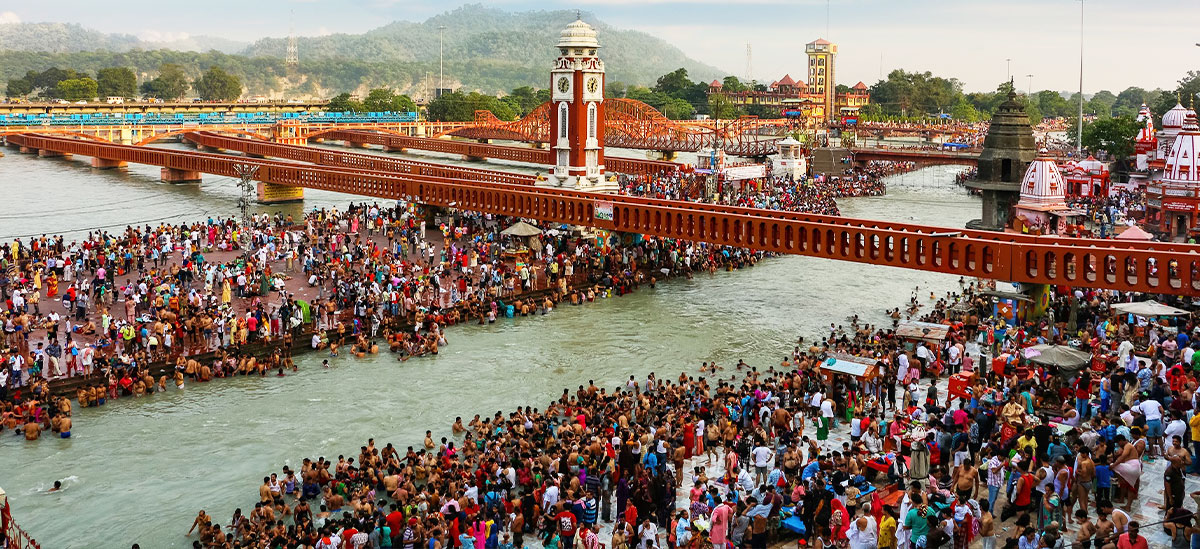
- Arrival Time: The ghats become incredibly crowded, especially on weekends and auspicious days. To secure a clear view of the priests and the flickering lamps, it is best to arrive at least 45 to 60 minutes early.
- Best Vantage Point: The steps directly across from the Brahmakund (the main sacrificial area) or near the Clock Tower offer the most cinematic views of the ceremony.
- Cost: There is no ticket or entry fee to witness the Aarti, as it is a public religious ritual. However, you may choose to make a small donation or purchase a leaf-boat (diya) to release into the river.
- Duration: The main ritual usually lasts for about 30 to 45 minutes, but the atmosphere remains meditative for long after the last lamp is extinguished.
Since the evening Aarti begins precisely as the sun dips below the horizon, arriving by 5:30 PM during this time of year ensures you can soak in the gathering spiritual energy before the first bell rings.
Where the emerald waters of the Shivalik hills break into the sunlight of the plains, Haridwar stands as an eternal bridge between the mortal and the divine. Often whispered as Gangadwara, this is where the celestial river finally descends from her mountain throne to touch the earth with grace. It is a city that breathes through its stone steps and ancient rituals, serving as the essential "Tirtha"—a spiritual crossing point—where the heavy silence of the Himalayas meets the vibrant pulse of Indian faith. As the gateway to the Char Dham, Haridwar is not merely a stopover; it is a purification of the soul before one ascends into the high-altitude abodes of the gods. The soul of the city resides at Har Ki Pauri, the "Footsteps of the Lord," where the current of the Ganga is swiftest and most sacred. Here, time seems to dissolve. By day, the ghats are a mosaic of saffron robes, marigold garlands, and the rhythmic dip of pilgrims seeking a fresh beginning. By twilight, the atmosphere shifts into a cinematic display of devotion during the Ganga Aarti. The air thickens with the scent of camphor and incense as massive brass lamps are hoisted toward the sky, their flames reflecting in the dark water. Thousands of tiny leaf-boats, laden with flickering tea lights, drift downstream like a fallen constellation, carrying the silent prayers of a nation. Beyond the riverbanks, Haridwar is a living library of Vedic wisdom and ancestral heritage. High above the skyline, the temples of Mansa Devi and Chandi Devi keep watch from their mountain perches, reachable by cable cars that offer a bird’s-eye view of the winding river. In the narrow, winding alleys below, the city’s famous Pandas (genealogists) maintain handwritten records of family trees that span dozens of generations—a unique link to the past found nowhere else on earth. Whether it is the quiet discipline of a forest Gurukul or the grand, chaotic energy of the Kumbh Mela, Haridwar remains a place of profound transformation, where every drop of water tells a story of immortality.